
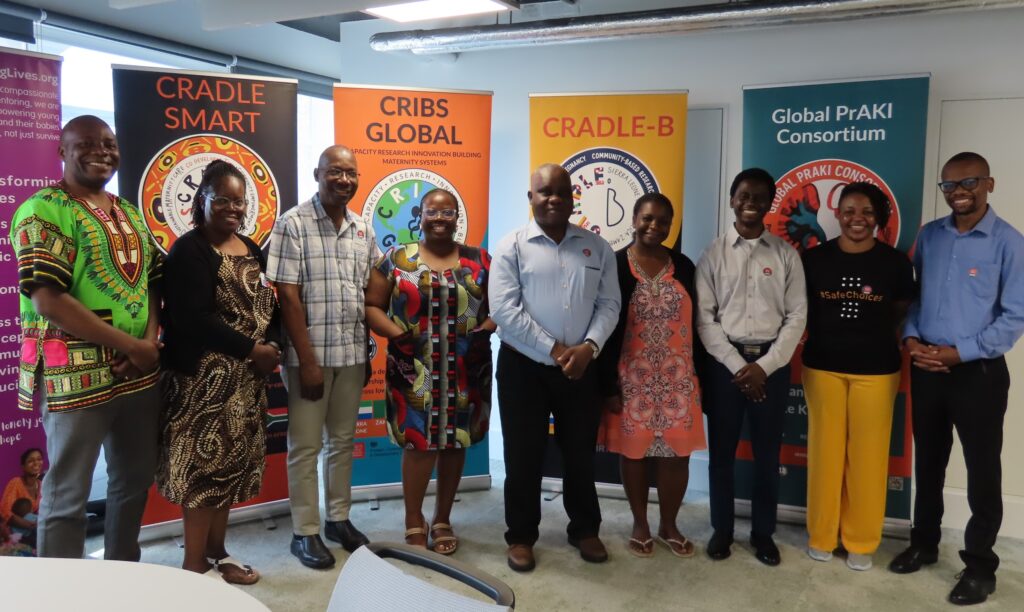
For over two decades, Dr Sebastian Chinkoyo has been a leading figure in obstetrics and gynaecology in Zambia and for more than ten years, a vital part of the CRIBS Global family. As Principal Investigator for PAPAGAIO projects at the Ndola site in Zambia and a long-standing collaborator on CRADLE research studies, his journey with King’s College London tells the story of how research partnerships can grow, deepen, and outlast any single project.
A partnership that began in 2012
Dr Chinkoyo’s connection with King’s began through a link between St. Thomas’ Hospital and Ndola Teaching Hospital, starting with African Partnerships for Patient Safety (APPS), a World Health Organisation-supported infection prevention and control project and surgical safety checklist implementation. That early collaboration took him to St Thomas’ Hospital twice, in 2013 and 2017, and saw him coordinate a student exchange programme bringing King’s students to Ndola for clinical experience.
It was through this growing partnership that he became involved with the CRADLE research programme, starting with CRADLE-1 and the introduction of the original vital sign alert device. From there, his involvement deepened significantly: he served as a country local lead on the CRADLE-3 stepped wedge cluster randomised controlled trial, spanning eight countries including India, Haiti, Uganda, Zimbabwe and Zambia, and then saw CRADLE-4 through from start to finish, with results disseminated in 2022, the same year he travelled to London again to participate in the collaborators’ results-sharing meeting.
Today, that partnership continues through his role as the Ndola site Principal Investigator for the PAPAGAIO projects in Zambia, alongside ongoing involvement in CRADLE-Smart and CRADLE-B research studies.

A career built on teaching as much as clinical practice
Dr Chinkoyo’s path into obstetrics wasn’t planned from the start. He graduated from medical school with an interest in general surgery, but it was during his internship in 1990-1991, on rotating through obstetrics and gynaecology, that his real passion for obstetrics took hold. He went on to complete his Master of Medicine in Obstetrics and Gynaecology at the University of Zambia in 2000, having been sponsored through his training by a mining company he worked with from 1992. As a specialist obstetrician and gynaecologist, he served the mining company for eight years before moving into government service – a move, he says, that opened the door to the opportunities and partnerships that have shaped his career since.
In 2023, Dr Chinkoyo opted for early retirement from Zambia’s Ministry of Health after a long career as a hospital consultant. Rather than stepping back, he joined the Copperbelt University’s medical school in Ndola as a senior lecturer, where he remains closely involved in clinical work and continues to lead students through clinical rotations at Ndola Teaching Hospital.
Teaching, he says, is where much of his current fulfilment comes from: “I’m enjoying imparting my knowledge, my skills to the younger generation.” Many of the specialists he has trained now practise independently, but, as he puts it, they still look to him as their teacher and mentor.

On partnership and mentorship
Reflecting on his years with CRIBS Global, Dr Chinkoyo pointed to Professor Andrew Shennan as a particular source of inspiration, having first undertaken an observership programme with him in clinic at St. Thomas’ Hospital in 2013. He described Professor Shennan’s humility and commitment to developing researchers as qualities that have shaped his own approach to mentoring the next generation, a fitting echo, given how many young specialists now credit Dr Chinkoyo with the very same influence.
As his academic career continues, Dr Chinkoyo remains committed to the research partnership that has run alongside his clinical and teaching work for over a decade: “For as long as we have this partnership with King’s College London and the research projects that are ongoing, I’ll be very happy to be involved.”