
 A new study published this month in BMJ Global Health reveals how a community-led initiative, Gi4SaveLife, has dramatically increased voluntary blood donation in rural Sierra Leone, offering a scalable model for health systems across low- and middle-income countries.
 The challenge: a critical shortage with life-or-death consequences
Sierra Leone faces one of the world’s most acute shortages of voluntary blood donors. Only 15% of the country’s required blood supply comes from voluntary, non-remunerated donors. The rest depends on paid donors or family members in moments of crisis: a system that creates dangerous delays, financial hardship, and a persistently unsafe blood stock.
The consequences are stark. Postpartum haemorrhage is a leading cause of maternal death in Sierra Leone, and the inability to access safe blood quickly is a major contributing factor. Adolescent girls and pregnant women without family support are particularly vulnerable.
Historically, externally organised blood drives have failed to take root. Cultural myths, including fears that donating blood leads to illness, infertility, or that donated blood may be used in witchcraft, combined with limited awareness and a lack of community trust, have undermined top-down campaigns.
 The solution: putting communities in charge
Gi4SaveLife, developed by Lifeline Nehemiah Projects (LNP), a Sierra Leonean community-based organisation, and supported by King’s College London, takes a fundamentally different approach. Rather than sending health workers in to collect blood and leave, Gi4SaveLife places ownership, responsibility, and social capital directly within the community.
The model builds on the principles of LNP’s 2YoungLives programme, a community-led mentoring initiative for adolescent pregnant girls that reduced maternal and perinatal mortality by 48%.
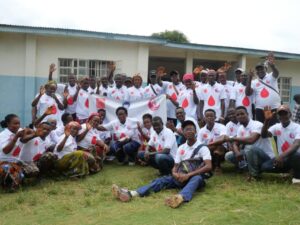
Five community ‘hubs’ were established in the rural districts of Kono and Kenema in Eastern Sierra Leone. Locally nominated volunteers led each hub, respected figures within their own communities, who received focused training on blood donation facts, dispelling myths, and peer-to-peer communication. Their role extended beyond recruitment: hub members supported donors during drives and followed up to ensure their well-being.
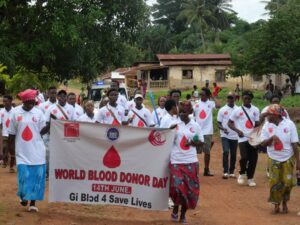
Monthly blood drives were held in accessible community locations, using non-monetary incentives aligned with WHO recommendations: food and refreshments, branded wristbands, and community events such as football matches. Local radio stations: Eastern Radio and Radio Maria, and a television feature amplified the message further.
The results: 539 units, zero to start
Over eight months (July 2022 – May 2023), Gi4SaveLife collected 539 units of blood from 376 unique donors, exceeding the project’s target of 510 units. Before the initiative began, the partner hospital, Koidu Government Hospital, had zero voluntary donors. All transfusions relied entirely on family replacement and paid donations.
Perhaps the most telling indicator of lasting impact: 43% of all donations (161) were repeat donations, rising to 66% by the final blood drive in May 2023. Donation numbers held steady even after financial stipends for hub volunteers were phased out – strong evidence that the model had cultivated genuine, self-sustaining community commitment.
The initiative also cut costs: in the final sustainable phase, the cost per unit fell by 40% compared to standard hospital-led models.
A donor survey found that the most common motivation was altruistic: 71% cited a desire to save lives. But other factors mattered too: 52% valued the social recognition of being known as a blood donor; 49% cited the assurance that blood would be available for their own family if ever needed; and 48% valued access to confidential health screening.
“Blood donation should be seen as a meaningful and rewarding act that brings joy through saving lives. When you donate blood, you are not only helping to save another person’s life, but you also gain valuable insight into your own health condition through the screening process.”
A voluntary blood donor, Gi4SaveLife
Voices from the initiative
“By investing in local leadership and designing an approach rooted in trust and mutual respect, our volunteers have transformed blood donation into a meaningful, community-driven act of solidarity.”
Prince Tommy Williams, Lifeline Nehemiah Projects
“I used to believe and say that blood donation was demonic until my wife was due to deliver twins and was severely anaemic. The blood donated by community volunteers was used to save the lives of my wife and our twins. That experience completely changed my mindset and perception about blood donation.”
Shek Osma Koroma, community stakeholder
“In our community, many people were initially afraid to voluntarily donate blood because of cultural myths and limited understanding of the importance of voluntary blood donation. However, because we live among them, speak the same language, and have earned their trust, they listened to us. Once we shared accurate information and respectfully addressed their questions and concerns, perceptions about blood donation began to change positively.”
Edward Robbin Ngeyawo, Community Hub member, Lifeline Nehemiah Projects
“There is an urgent need to champion local solutions to local problems. Gi4SaveLife demonstrates the power of building local capacity.”
Dr Cristina Fernandez Turienzo, King’s College London
“By empowering trusted community champions to dismantle deep-rooted myths with facts, Gi4SaveLife created a sustainable, cost-effective pipeline of voluntary donors.”
Ms Lucy November, King’s College London
A model for the future
The study’s authors argue that the success of Gi4SaveLife points to an urgent need to shift investment away from episodic, externally driven blood drives and towards long-term support for local civil society organisations working in coordination with national health authorities.
While the initiative was piloted in one district, the core principles of local ownership, trusted champions, non-monetary incentives, and culturally grounded communication are considered transferable to other low-resource settings facing similar challenges. The authors note that replicating the model would require identifying similarly trusted local organisations and ensuring integration with national blood transfusion guidelines.
Gi4SaveLife is more than a logistical fix. It is a transformative social process that strengthens community cohesion, replaces fear with knowledge, and embeds a culture of shared responsibility for health.
About the initiative
Gi4SaveLife was developed by Lifeline Nehemiah Projects in partnership with King’s College London and Koidu Government Hospital. The initiative was funded by UK Research and Innovation through the Economic and Social Research Council (King’s College London International Impact Fund: ‘Blood Donation in Sierra Leone’).
The study, ‘Gi4SaveLife: a community-led model for sustainable voluntary blood donation in rural Sierra Leone’, is published in BMJ Global Health (2026;11:e023974).
Read the full paper: https://gh.bmj.com/content/11/6/e023974